How to rank in ChatGPT when you sell an app
How to rank in ChatGPT depends on what you sell: an app can be named in ChatGPT's answers or suggested as a plugin, and each path moves for different reasons. Answers draw on pages ChatGPT Search can read. Plugin suggestions depend on OpenAI's selection and the plugin's utility and user satisfaction. Neither path can be bought.
| Path | What appears | What to improve | What to measure |
|---|---|---|---|
| ChatGPT answer | Your app is named in a response | Clear, accessible pages that explain the app and the job it does | Recommendation rate, position, sources and citations across repeated prompts |
| Plugin directory or suggestion | Your plugin appears in directory search or a selected in-chat suggestion | Accurate metadata, useful tools, reliable behavior and a clear listing | Directory position and whether the plugin is suggested in relevant prompts |
A single response is not a stable rank. Ask the same buyer questions more than once and track how often your app appears and where. OpenAI says ads do not influence ChatGPT answers, and plugin developers cannot request enhanced distribution.
Two ways an app shows up in ChatGPT
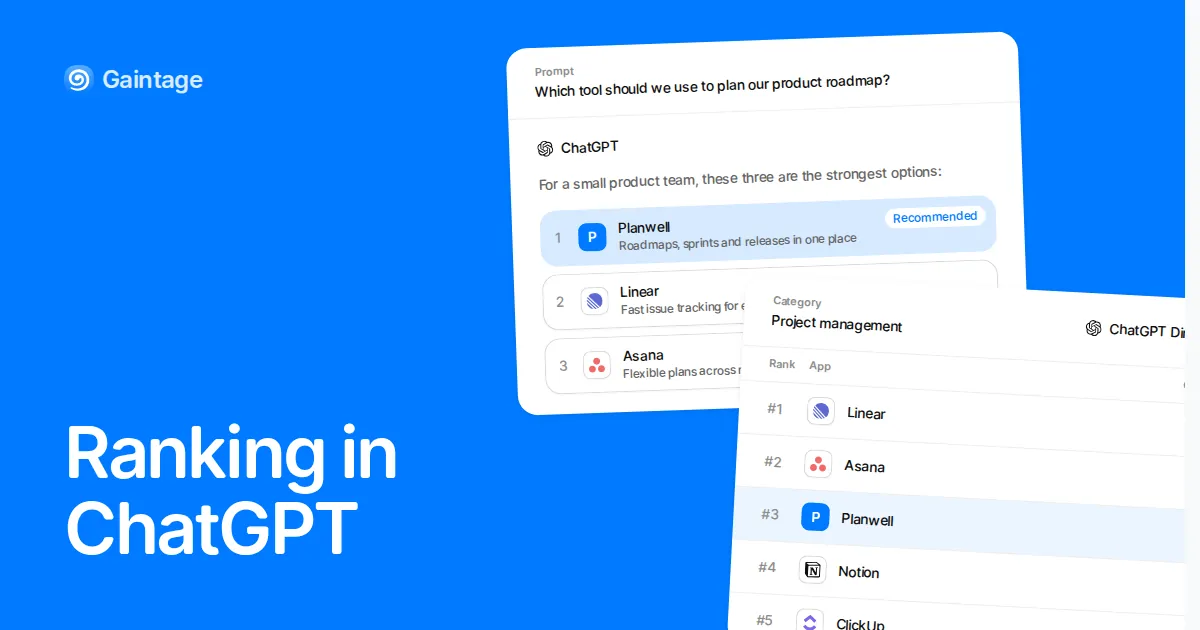
ChatGPT can name an app in an answer, often with search sources, or a person can find a plugin in the directory. OpenAI also selects some plugins for enhanced distribution and proactive suggestions. The answer and plugin paths have different controls and should be measured separately.
For app makers, that means a website page may help ChatGPT explain what your app does, while a plugin listing helps people find a tool they can use in the conversation. Gaintage tracks app recommendations across repeated prompts and directory positions for supported listings. Run the numbers and see how often ChatGPT names your app across many runs.
What does ChatGPT read before it names an app?
OpenAI documents how its crawlers work, but not a formula that ranks apps in answers. OAI-SearchBot helps surface websites in ChatGPT search. If a site blocks OAI-SearchBot, OpenAI says its pages will not appear in ChatGPT search answers, though they may still appear as navigational links. ChatGPT-User may visit a page when a user's request requires it.
OpenAI does not publish a weighting formula for App Store reviews, ratings, Reddit threads, comparison pages or your own site. Check the sources ChatGPT cites for the prompts buyers ask in your category. That shows which pages are being surfaced in that response; it does not prove that a source caused the recommendation.
How do you get your app mentioned in ChatGPT answers?
Make the pages ChatGPT Search can read explain what your app does, who it is for and which platforms it supports. Then check the sources and descriptions ChatGPT returns for the questions a buyer might ask.
- Allow OAI-SearchBot in
robots.txtif you want your pages eligible for ChatGPT Search answers. - Give each important job its own page. State the category and use case near the start, then explain what the product does.
- Use the same app name and concise description on your site, App Store, Google Play and relevant directory listings.
- Keep product details current. Date information that changes, such as supported integrations or availability.
- Review comparison and “best app” pages that appear for your category. Make sure they describe your product accurately and link to a useful product page.
- Run the same buyer prompts again after meaningful changes and compare the answers and cited sources.
These steps improve clarity and eligibility; they do not guarantee a recommendation or a timetable. OpenAI's documentation does not say that a specific review site, rating or structured-data change will earn an app a place in an answer.
How to rank in ChatGPT as a plugin
A plugin can appear in directory search, and OpenAI may select it for enhanced distribution. OpenAI says developers cannot request that placement; selection depends on strong real-world utility and user satisfaction. The directory includes curated collections and category pages, so a plugin may be findable by name or direct link without being featured.
You control the accuracy of the listing and the quality of the plugin. OpenAI sets limits for fields such as the plugin name, subtitle, description and starter prompts. Tool descriptions should make clear when a tool is useful, and the tools should work reliably. Changes to plugin listing details go through review; MCP tool definitions also receive continuous review.
OpenAI does not document that a plugin listing improves the chance of the same app being named in a general answer. Treat directory visibility and answer recommendations as separate measurements. OpenAI’s plugin review requirements explain how directory placement and proactive suggestions work.
When does an app need a ChatGPT plugin?
Build a plugin when the job can happen inside a conversation: look something up, create or update a record, book a service, or act on the user's data. If the app's value is mainly information or a workflow that happens elsewhere, being clearly described in answer sources may be enough. Plugins can include a remote MCP server, skills, or both.
A plugin also has specific policy and engineering requirements and goes through review. A plugin with server-backed tools needs a hosted MCP server; skills-only plugins do not. OpenAI's guidelines restrict plugins from serving ads and allow sales of physical goods; digital subscriptions, credits and freemium upsells cannot be sold inside the plugin. A plugin may explain that a feature requires another plan and link to an informational plan page, but it cannot send the user to a checkout for that purchase. Users can sign in to an existing paid account. OpenAI's current guidelines also state that projects with EU data residency cannot submit plugins using MCP servers.
Check the current plugin guidelines before building or changing a submission, since platform requirements can change.
How long does it take to rank in ChatGPT?
OpenAI documents one specific timing: its search systems may take about 24 hours to apply a robots.txt change. It does not publish a timetable for a new page to appear in answers or for a plugin to earn enhanced distribution. OpenAI scans MCP servers daily, while listing edits require a new reviewed version.
Record a baseline before a change, then rerun the same prompts and compare the results. For a plugin, separately check directory position and whether it is suggested in relevant conversations. Avoid treating one answer or one day as a durable rank.
How to measure where your app ranks in ChatGPT
Run the same buyer prompts repeatedly and record whether your app appears, where it appears and which competitors are named. Track the cited sources when search is involved. For plugins, check directory position for relevant keywords and categories and record suggestion appearances separately.
Gaintage tracks prompts across ChatGPT, Gemini, Google AI Mode, AI Overviews and Copilot, and tracks supported directory rankings. Each plan uses three platforms selected by the customer. Compare Visibility, Recommendation rate, Share of voice and Position across the prompts and platforms in your plan; the measures answer different questions about discovery.
Repeated runs reduce the chance that one unusual response drives the conclusion. They still do not show why a model produced a particular answer, and they do not replace product analytics for installs or revenue.
What does not move your rank in ChatGPT?
Paying for an ad does not improve an answer: OpenAI says ads do not influence the answers ChatGPT gives. Plugin directory placement also cannot be bought or requested. OpenAI prohibits plugin listing copy designed to steer the model into preferring a plugin, and plugins cannot serve ads.
Blocking OAI-SearchBot prevents a page from appearing in ChatGPT Search answers. It does not necessarily remove the page as a navigational link. Follow the current crawler and plugin documentation rather than assuming that a ranking trick applies to both paths.